


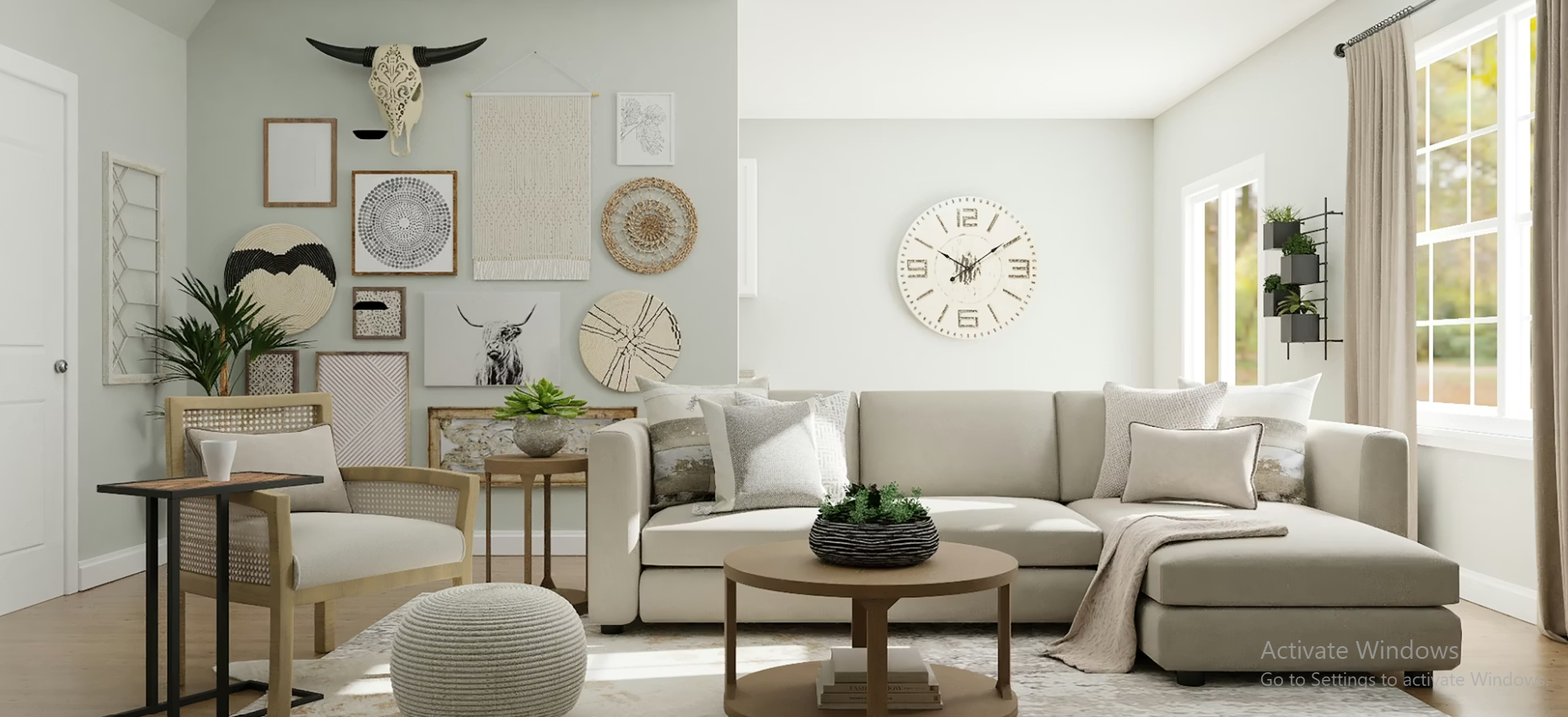
You’ve filled the room. That’s not the problem.
The sofa is right, the rug is intentional, the lighting is warm, and there’s enough styling to make it feel considered. But when you sit down, the space doesn’t quite hold you. It looks like a finished room, but it doesn’t feel like one.
That “incomplete” feeling usually comes down to a few subtle but fixable things—none of them dramatic, all of them important.
Everything Is at the Same Visual Level
Most living rooms unintentionally compress themselves. The sofa, coffee table, media unit, and even artwork tend to sit within the same horizontal band, which makes the room feel visually heavy and slightly boxed in.
What’s missing is vertical movement.
This doesn’t mean adding more furniture—it means guiding the eye upward. Taller artwork, floor lamps with presence, or even something as simple as raising your curtain height closer to the ceiling can change how expansive the room feels.
This is one of the few places where window treatments genuinely matter. Custom drapes, when hung high and cut to full length, create a vertical line that instantly makes the room feel taller and more resolved. It’s not about decoration—it’s about correcting proportion.
Your Layout Is “Correct” but Not Comfortable
A lot of living rooms are arranged for symmetry or visual balance, not for how people actually sit and move.
Coffee tables are placed too far to reach comfortably. Seating faces a TV but not each other. Walkways cut awkwardly through the space. Everything looks neat—but doesn’t function easily.
Before adding anything new, adjust what you already have:
- Pull the seating slightly closer together
- Make sure surfaces are within arm’s reach
- Leave natural walking paths instead of forcing symmetry
A room starts to feel complete when it works without effort.
The Lighting Is One-Dimensional
If your entire room relies on one overhead light or a single lamp, it will always feel flat by evening.
A finished living room has layers of light:
- Ambient (overall glow)
- Task (reading, focused areas)
- Accent (mood, depth)
Even adding one additional light source—like a floor lamp in a dark corner—can create depth that makes the room feel more complete.
Natural light matters too, but not in an abstract way. If your windows are either too harsh during the day or too exposed at night, the room never settles properly. This is where something like well-fitted custom roman shades in thick fabrics can help—not as decoration, but as a way to control light. They soften glare during the day and make the room feel more enclosed and intentional in the evening.
The Scale Is Slightly Off
This is one of the biggest reasons a room feels “almost right.”
- A rug that’s too small makes everything float
- Art that’s undersized feels like an afterthought
- Curtains that are too narrow or too short make walls feel awkwardly cut
Individually, these don’t seem like major issues. Together, they create visual imbalance.
Fixing scale doesn’t require replacing everything. Sometimes it’s as simple as:
- Choosing a larger rug next time
- Grouping smaller art pieces instead of leaving one isolated
- Ensuring curtains have enough width to look full, not stretched
Again, this is where customisation helps—but only because it solves a real problem. Custom drapes ensure correct width and length, which avoids the slightly “off” feeling that ready-made options often create.
There’s No Material Contrast
A room full of similar textures feels flat, even if the colours are beautiful.
If everything is:
- smooth
- matte
- or similar in finish
The room lacks depth.
You want contrast:
- soft upholstery against something structured
- a wooden surface against fabric
- a slightly heavier textile against lighter ones
This is less about adding more and more about mixing what you already have. Even something like introducing a textured fabric at the windows can help balance smoother surfaces elsewhere—but it only works when it’s part of a broader mix, not a standalone fix.
The Room Isn’t Anchored Emotionally
This is harder to define, but easy to feel.
Some rooms look good but don’t feel like anyone lives there. They lack something personal—something that makes the space feel grounded.
This doesn’t mean cluttering it with décor. It means:
- keeping a book you actually read
- displaying something with memory attached
- allowing one or two elements that aren’t purely aesthetic
A finished room has a point of view. Without that, it will always feel staged.
Final Thoughts: Don’t Stop at “Done” Instead of “Resolved”
Most people decorate until the room looks acceptable—and then stop. But “acceptable” and “complete” are not the same thing.
A complete room feels:
- balanced in height and scale
- comfortable in layout
- layered in light
- intentional in detail
Sometimes, the missing piece is something structural, like properly scaled living room window treatments. Sometimes, it’s just rearranging what you already have.
But the shift happens when the room stops being a collection of things and starts behaving like a space.
If you want to know about Making the Case for Upgrading or Replacing Your Garage Door then visit our Home improvement category.
