


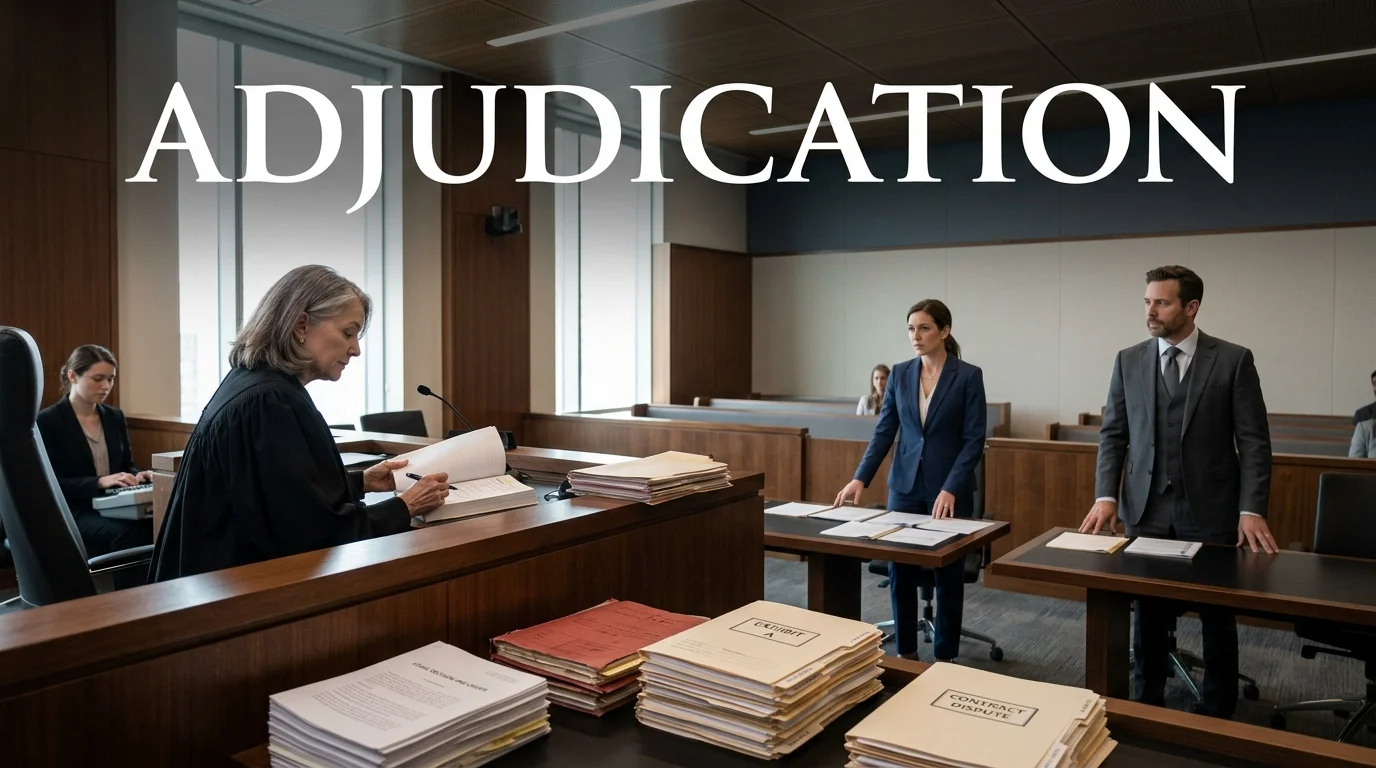
Short answer: Adjudication Meaning refers to the formal process of reviewing a dispute, claim, or case and reaching an official decision. In legal settings, a judge, tribunal, agency, or other authorized decision-maker considers the facts and applicable rules before deciding the parties’ rights, duties, or requested relief.
You may see the word in court documents, government notices, benefit claims, or contracts. A case described as “under adjudication” has not necessarily been approved or denied. It usually means the matter is still being considered and that a formal decision is pending.
| Context | What the term usually describes | Possible decision-maker | Typical result |
|---|---|---|---|
| Court dispute | Formal resolution of a legal case | Judge or court | Judgment, order, or ruling |
| Government matter | Formal review of an individual case | Agency official or administrative judge | Agency decision or order |
| Private dispute | A process chosen to resolve a disagreement | Arbitrator or other authorized neutral | Award or decision |
| Claim review | Examination of facts and eligibility under set rules | Authorized reviewer or agency | Approval, denial, or another determination |
Key Takeaways
- The term describes an official decision-making process, not merely a discussion between two sides.
- “Under adjudication” typically means a matter is still under review or pending decision.
- A judgment is a specific court outcome, while the broader process may lead to that judgment.
- A conviction concerns criminal guilt.
- Mediation does not give the mediator the authority to impose a decision.
- The exact procedure depends on the court, agency, contract, and jurisdiction involved.
Adjudication Meaning in Law: What Is Being Decided?
In law, the term generally refers to the process of resolving a dispute through an authorized decision-maker. Cornell Law School’s Legal Information Institute describes it as the legal process of resolving a dispute or deciding a case. The same word can also refer to the resulting judicial decision.
The key idea is authority. The person or body deciding the matter has the legal, administrative, or agreed-upon authority to reach a result. That distinguishes a formal determination from an ordinary negotiation between the parties.
Legal vocabulary often changes meaning depending on the context. Magazinted’s guide to understanding legal jargon can help when a court notice contains several unfamiliar terms. Another example is the site’s explanation of condemnation and its different meanings.
How the Decision Process Usually Works
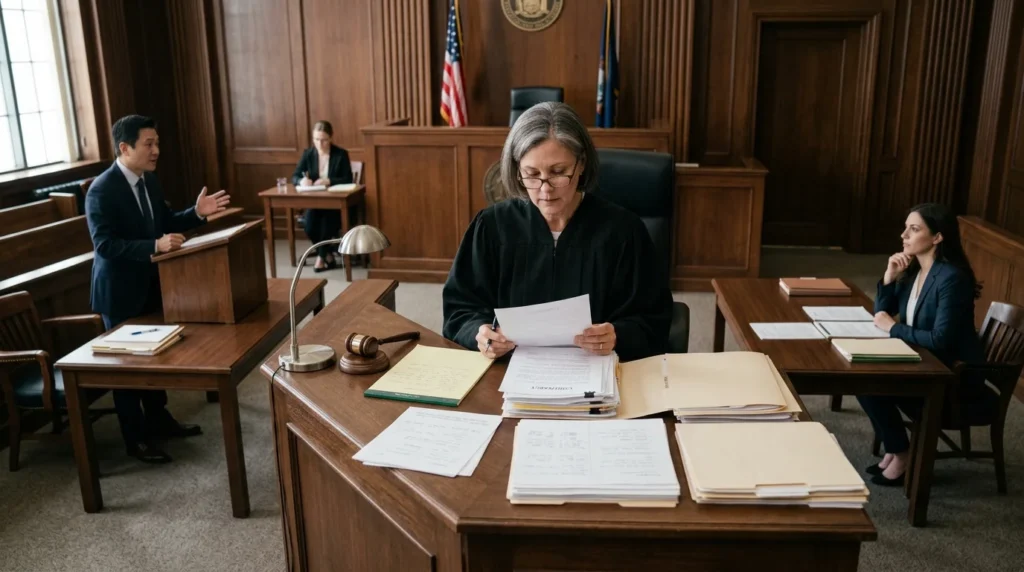
The exact rules vary, but a formal case review often follows a recognizable sequence:
- A matter is submitted. A lawsuit, petition, application, claim, charge, or administrative request starts the process.
- The other side receives notice. When required, affected parties may respond.
- Evidence and arguments are reviewed. The decision-maker examines documents, testimony, legal rules, or other relevant material.
- A determination is made. The authorized person or body decides the issue presented.
- A written result may follow. Depending on the forum, this may be called a judgment, order, award, determination, or decision.
A small civil dispute can therefore move from filing to a hearing and then to a judgment. Readers dealing with lower-value civil cases may also find Magazinted’s small claims legal guide useful.
Not every matter requires a courtroom trial. Agencies can decide cases through administrative procedures, while contracts can direct certain private disputes to arbitration.
What Does “Under Adjudication” Mean?
When something is under adjudication, an authorized decision has not yet been made. Cambridge Dictionary defines the phrase as referring to an issue that is “being decided,” including matters before the courts.
That status should not be interpreted as a prediction of the outcome. It does not automatically mean a claim will be denied, a defendant will lose, or an applicant will qualify.
For example, a government notice may state that a claim is under review while officials examine eligibility and supporting records. A court matter may remain pending while the judge considers evidence or legal arguments.
If the phrase appears on a notice that affects money, liberty, employment, benefits, or another legal right, check the issuing body’s instructions. Deadlines and available responses can differ significantly by forum.
How It Differs From Judgment, Conviction, Arbitration, and Mediation
Several legal terms describe related stages or methods, but they are not interchangeable.
| Term | What it describes | Who makes the decision? | Typical result |
| Adjudication | Formal resolution of a case, claim, or dispute | Authorized judge, agency, tribunal, or other decision-maker | Decision, order, judgment, or award |
| Judgment | A court’s formal decision on a matter | Court or judge | Court judgment |
| Conviction | A finding or legal result establishing criminal guilt | Criminal court process | Criminal conviction |
| Arbitration | Private dispute resolution based on an agreement or applicable rules | Arbitrator | Arbitration award |
| Mediation | Facilitated negotiation between the parties | Parties decide; mediator facilitates | Settlement only if the parties agree |
Mediation differs most clearly in that the mediator typically does not decide who wins. The mediator helps the parties work toward their own agreement. Arbitration is closer to a formal determination. An arbitrator hears the dispute and issues an award. Many arbitration arrangements produce binding results, while court review may be limited under applicable law.
A judgment is narrower in scope. It is the court’s formal result, while the broader decision-making process includes the steps leading to that result. A conviction is narrower still. It concerns criminal guilt, so a civil property ruling or administrative benefits decision cannot be called a criminal conviction.
Where the Term Appears Outside Ordinary Court Cases
Courts are only one setting in which formal case decisions occur. Federal administrative law also uses this terminology.
The federal statute at 5 U.S.C. § 554, titled “Adjudications,” governs agency proceedings that another statute requires to be determined on the record after an agency hearing. It also sets the notice and hearing requirements that those covered matters must follow.
Government agencies may need to determine matters involving benefits, licenses, regulatory issues, or other individual rights under specific rules. The procedure can look different from a civil trial, even though an official decision is still being made.
The word also appears more broadly in English when someone has the authority to judge a dispute or competition. Cambridge Dictionary includes both legal and more general decision-making uses. That is why context matters. A sentence about a government hearing may have procedural consequences that the same word would not carry in the context of a competition.
Deferred Adjudication: Why the Wording Matters
Deferred adjudication is a specific criminal-law procedure used in some jurisdictions. It should not be confused with the general definition above.
Under some state systems, a defendant may enter a guilty or no-contest plea while the court postpones a final judgment. The person must then satisfy court-ordered conditions. Successful completion may allow the case to end without a standard conviction being entered, depending on local law and the program involved.
The details matter. Eligibility, public-record consequences, future disclosure requirements, immigration effects, firearm restrictions, and the treatment of future offenses can vary by jurisdiction. Therefore, a person should not assume that “deferred” means the incident disappears. Anyone facing that choice should read the actual court order and obtain legal advice relevant to the state and case involved.
What Happens After a Case Is Decided?
Once the decision-maker issues a result, the next step depends on the type of proceeding. A court judgment may need to be enforced. An administrative decision may have its own review process. An arbitration award may be subject to rules governing confirmation or limited court challenges.
A losing party may also have the right to seek reconsideration, administrative review, or an appeal. The available route and filing deadline depend on the forum and governing law.
Magazinted’s overview of the role of an appeal attorney provides more context on what happens when a party asks a higher court to review an earlier decision.
Finality also matters. Once a qualifying decision becomes final, legal rules can restrict attempts to relitigate issues or claims that have already been resolved.
The Bottom Line
When you encounter this legal term, focus on three questions: Who is deciding the matter, what issue are they deciding, and has a final decision been issued? Those questions can help you determine whether you are looking at a pending review, a completed ruling, or a specialized process such as arbitration or a deferred criminal case.
For more plain-English explanations of legal concepts and court terminology, browse Magazinted’s Law section.
Frequently Asked Questions
It means officially deciding a dispute, claim, or case after reviewing the relevant facts and rules. The person or body making the decision must have the authority to do so.
No. It usually means the matter is still under review or pending a decision. The outcome may be an approval, denial, judgment, order, or another formal determination.
No. Adjudication is a broad decision-making concept. A conviction is a criminal case outcome and represents a legal determination of guilt.
A civil dispute, agency licensing case, or benefits matter can be formally decided without resulting in a criminal conviction.
Not exactly. Arbitration is one specific method of resolving disputes outside ordinary court proceedings. An arbitrator considers the case and issues an award.
The broader legal concept can cover decisions made by courts, agencies, tribunals, and other authorized bodies.
An adjudicator is a person authorized to decide a matter. Depending on the system, that person might be a judge, an administrative official, a hearing officer, a tribunal member, or an arbitrator.
The person’s authority and the effect of the decision depend on the rules governing the proceeding.
