


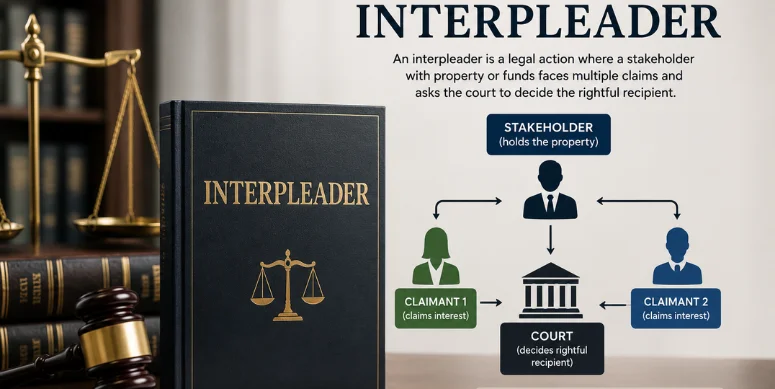
Interpleader is a civil court procedure used when one person or organization holds money or property claimed by two or more competing parties. The holder, called the stakeholder, asks one court to decide who is entitled to the asset, reducing the risk of paying twice or defending separate lawsuits over the same fund.
In the United States, the exact route depends on whether the case proceeds under a federal rule, a federal statute, or state law. The basic goal remains the same: bring the competing claims before a single court and let that court determine who should receive the disputed asset.
| Key point about Interpleader | What it means |
|---|---|
| Stakeholder | The person or organization holding the disputed money or property |
| Claimants | Two or more parties asserting competing rights to the same asset |
| Main purpose | Avoid multiple lawsuits or the risk of paying the wrong claimant |
| Federal routes | Federal Rule of Civil Procedure 22 or 28 U.S.C. §1335 |
| Common situations | Life insurance proceeds, escrow funds, bank funds, judgments, and disputed property |
| Possible result | The stakeholder may be discharged while the claimants continue the dispute |
Key Takeaways
- The stakeholder need not choose a winner when rival claims pose a real risk of multiple liabilities.
- Federal Rules 22 and 28 U.S.C. §1335 provide different routes into federal court.
- Section 1335 currently applies to qualifying property or obligations with a value of at least $500 and requires a deposit or an approved bond.
- State courts also have their own rules, so the procedure and filing requirements can differ by jurisdiction.
If court terminology is unfamiliar, Magazinted’s guide to understanding legal jargon provides a useful starting point.
How Interpleader Works in U.S. Courts
The procedure usually begins because a neutral holder faces inconsistent demands. Paying one claimant may trigger a lawsuit from another. Holding the asset indefinitely may also create costs and legal risk.
1. Competing claims arise
Suppose a life insurance company holds a $500,000 death benefit. Two people each claim they are the proper beneficiary. The insurer does not want to decide the dispute at its own risk. A mistaken payment could expose it to a second claim involving the same policy proceeds. Life insurance disputes are a common example of this type of case.
2. The stakeholder brings the claimants into one case
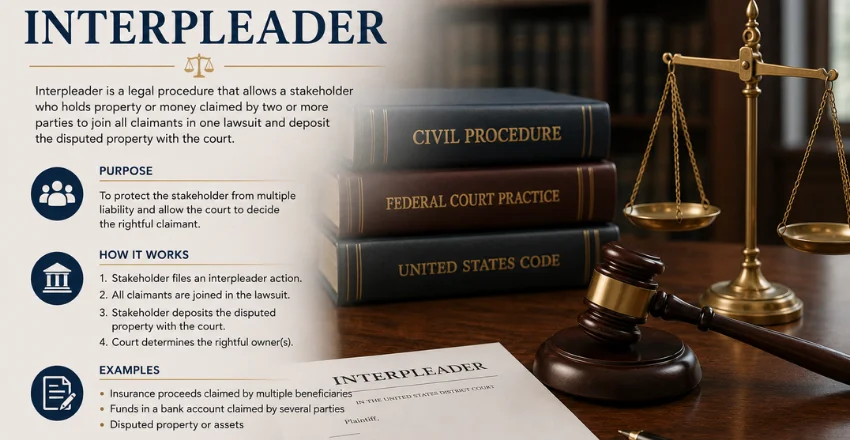
Federal Rule of Civil Procedure 22 allows a plaintiff facing double or multiple liability to join the competing claimants. A defendant already facing that problem can seek the same relief through a counterclaim or crossclaim. The claimants do not need identical legal theories.
Rule 22 expressly allows adverse and independent claims, even when they do not share a common origin.
3. The disputed asset may be placed under court control
The requirements depend on the route used. Under 28 U.S.C. §1335, the stakeholder must deposit the disputed money or property into the court registry or provide an approved bond. The federal statute applies when the property or obligation is worth at least $500, and its jurisdictional requirements are met.
4. The court addresses the stakeholder’s position
Once the court determines that the procedure is proper, a neutral stakeholder may seek release from further liability concerning the disputed fund. For statutory cases, 28 U.S.C. §2361 expressly says the district court may discharge the plaintiff from further liability. Courts may also restrain competing proceedings affecting the same property.
Release is not automatic in every dispute. A stakeholder accused of separate wrongdoing may face claims that go beyond deciding who owns the fund. Federal decisions have recognized this distinction when considering whether a stakeholder should be dismissed.
5. The claimants litigate entitlement
After the stakeholder’s role is resolved, the remaining parties present their competing claims. The court then determines who has the superior legal right to the money or property. That final determination is a form of adjudication. Magazinted’s plain-English explanation of adjudication explains how courts and other authorized decision-makers resolve disputes.
Rule 22 vs. 28 U.S.C. §1335
The two federal routes serve a similar purpose, but their jurisdictional rules are different.
| Issue | Federal Rule 22 | 28 U.S.C. §1335 |
|---|---|---|
| Source | Federal Rules of Civil Procedure | Federal statute |
| Federal jurisdiction | Needs an independent basis for federal jurisdiction | The statute itself grants jurisdiction when its requirements are met |
| Amount | Ordinary jurisdictional rules apply | A disputed property or obligation must be at least $500 |
| Citizenship | Depends on the independent jurisdictional basis | Qualifying diversity between two or more adverse claimants |
| Deposit or bond | Rule 22 does not contain §1335’s statutory deposit condition | A deposit into court or an approved bond is required |
| Special venue rule | Ordinary federal venue rules generally govern | The venue may lie where one or more claimants reside |
| Injunction provision | §2361 does not apply merely because Rule 22 is used | §2361 authorizes specified protective orders |
When diversity jurisdiction under 28 U.S.C. §1332 supplies the independent basis for a Rule 22 case, the amount in controversy generally must exceed $75,000. The statutory route is broader in several procedural respects. Section 1397 permits a qualifying action to be brought in a federal judicial district where at least one claimant resides.
Section 2361 also gives the court specific authority concerning service, competing proceedings, and discharge.
Where This Procedure Appears in Real Life
Life insurance is one of the clearest examples. Problems can arise when a former spouse, current spouse, child, estate, or another person claims the same policy proceeds. Banks and escrow holders can face similar conflicts. An escrow company may receive inconsistent instructions from parties claiming the same funds.
Courts have long treated conflicting claims to escrowed property as a situation suited to a stakeholder action. The procedure can also involve settlement funds or judgment proceeds. One federal case, for example, involved a bank holding more than $500,000 in an escrow account while several defendants asserted competing rights to the remaining funds.
The important feature is not the industry. It is the conflict. A holder faces two or more serious demands concerning the same identifiable money, property, benefit, or obligation.
Federal Law Is Not the Only Source of Rules
State courts may provide comparable procedures through state statutes or rules of civil procedure. That distinction matters because jurisdiction, filing requirements, service rules, deposits, and available relief can differ from one state to another. A federal rule should not be treated as a universal instruction for every U.S. case.
Readers researching another legal term can browse Magazinted’s Law section for related plain-language explainers.
What to Do If You Receive a Stakeholder Complaint
Receiving this type of complaint means another party says you have a competing interest in the disputed asset. It does not mean the court has decided that your claim is valid or invalid. Read the summons and complaint carefully. Identify the money or property involved, the other claimants, the court, and the stated basis for jurisdiction.
Pay close attention to the response deadline because federal and state procedures can differ. Keep documents supporting your claim, such as beneficiary forms, contracts, account records, settlement papers, wills, assignments, or correspondence. A lawyer licensed in the relevant jurisdiction can assess the pleadings and the legal basis for your claim.
If the case later reaches an appeal, Magazinted’s overview of appeal attorneys and appellate procedure explains what that separate stage can involve.
The Practical Point
This procedure solves a narrow but serious problem: several parties demand the same asset from a holder who should not have to gamble on which demand is correct. If you hold disputed funds or receive a complaint involving competing claims, check the governing court rules before paying or transferring the asset.
Preserve the relevant records and consider advice from a lawyer licensed in the jurisdiction where the case is pending.
Frequently Asked Questions
It is a way for someone holding disputed money or property to bring the competing claimants before a single court. The court can then determine who has the right to the asset while reducing the holder’s exposure to inconsistent demands.
Usually, the point of the procedure is to avoid forcing the neutral holder to make that choice. The competing claimants present their positions, and the court decides entitlement if the parties do not resolve the dispute themselves.
No. A court may discharge a neutral stakeholder from liability connected with the disputed fund when the legal requirements are satisfied. Separate allegations of independent wrongdoing can complicate dismissal.
Rule 22 is a procedural rule and requires an independent basis for federal jurisdiction. Section 1335 is a jurisdictional statute with its own requirements, including a $500 threshold, qualifying claimant diversity, and a deposit or bond.
There is no single national timeline. A straightforward dispute may end after motions or through settlement, while a contested case may require discovery, hearings, or a trial. The court’s docket and the number of claimants also affect timing.
