


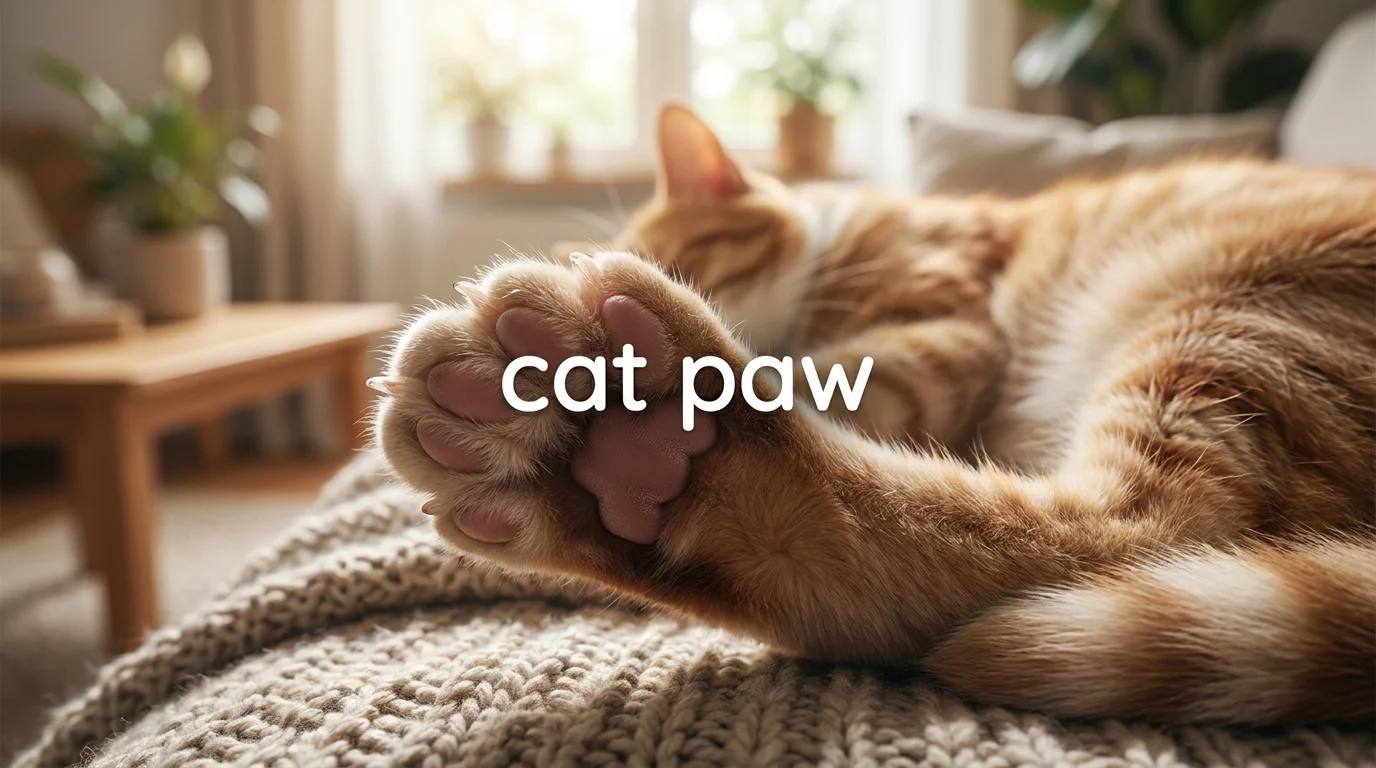
A cat paw may look small and simple, but it is a remarkably specialized part of a cat’s body. Paws help cats walk quietly, climb, grip, balance, feel their surroundings, absorb the force of landing, and protect the ends of their toes. Knowing what a healthy paw normally looks and feels like can also make it easier for cat owners to notice injuries or changes before they become more serious.
Most cats have five toes on each front paw and four on each rear paw, giving them 18 toes in total, although polydactyl cats can have additional digits. Each paw combines bones, joints, claws, sensitive skin, nerves, blood vessels, fur, and several types of pads that work together. Those structures make feline paws both durable and surprisingly sensitive.
Quick answer: A cat’s paw contains toes, retractable claws, highly sensitive nerves, blood vessels, and cushioned paw pads that help with traction, shock absorption, movement, and sensory feedback. Most cats have five toes on each front paw and four on each back paw, although some cats naturally have extra toes.
Cat Paw Anatomy at a Glance
| Part of the paw | What it does |
|---|---|
| Digital pads | Cushion individual toes and help provide grip |
| Central paw pad | Supports weight and helps absorb impact |
| Carpal pad | Found on the front legs and assists during braking and landing |
| Toes | Support movement, balance, climbing, and gripping |
| Dewclaw | An elevated front digit that can assist with gripping |
| Claws | Help cats climb, scratch, grip, defend themselves, and interact with objects |
| Nerves and receptors | Detect pressure, texture, movement, and vibration |
| Sweat glands | Allow a small amount of perspiration through the paws |
Cats are digitigrade animals, meaning they move primarily on their toes rather than placing the entire sole of the foot on the ground as humans do. This arrangement contributes to the quiet, agile movement associated with cats and allows the paws and limbs to work efficiently during running, jumping, stalking, and climbing. Sensitive receptors in the paws also provide information about pressure and vibration, making the feet an important sensory system as well as a means of locomotion.
Understanding Feline Paw Pads
The soft structures commonly called “toe beans” are more than a cute feature of feline anatomy. A typical paw includes smaller digital pads beneath the toes and a larger central pad that carries much of the contact load when the cat walks or lands. The front legs also have a carpal pad positioned farther up the limb, which can help provide extra contact and control during movements such as stopping or landing.
Paw pads contain cushioning tissue along with nerves and blood vessels, while their outer skin is built to tolerate ordinary contact with the ground. This combination helps protect deeper structures while still allowing cats to feel pressure, texture, and changes beneath their feet. The same sensitivity that makes the pads useful also means burns, cuts, abrasions, and foreign objects can be painful.
Why Are Some Paw Pads Pink and Others Black?
Healthy paw pads can naturally be pink, black, brown, grayish, mottled, or a combination of colors. Pigmentation is influenced largely by melanin and genetics, so cats with different coat and skin colors may have very different-looking feet. A cat with several colors in its coat may even have differently colored pads on the same paw.
The important comparison is usually your own cat’s normal appearance rather than another cat’s paw color. A naturally dark pad is not less healthy than a naturally pink one, and mixed pigmentation can be normal. A new or sudden color change accompanied by swelling, bleeding, sores, pain, or abnormal behavior deserves veterinary attention.
Cat Claws Are Part of the Toes
A cat’s claws are closely associated with the bones at the ends of the toes, rather than being simple surface structures comparable to removable accessories. Cats can extend their claws when they need extra grip for climbing, scratching, catching objects, or defending themselves and keep them retracted during many everyday activities. This arrangement protects the claw tips and contributes to the quiet way cats move.
Scratching is therefore normal feline behavior rather than automatically a behavioral problem. It helps cats interact with their environment, stretch, maintain their claws, and leave visual and scent-related signals. Providing suitable scratching surfaces and maintaining the nails are more cat-friendly approaches to normal scratching than treating the claws themselves as unnecessary.
Declawing Is Not the Same as Trimming Nails
Declawing, medically called onychectomy, should not be confused with cutting the pointed tip of a claw. The Feline Veterinary Medical Association states that the procedure involves amputation of the third phalanx, or P3, and strongly opposes elective declawing in most circumstances. It recommends alternatives such as appropriate scratching surfaces, routine claw trimming, environmental enrichment, and other behavior-management options.
For U.S. cat owners concerned about furniture damage or accidental scratches, a veterinarian can help develop a claw-management plan that suits the individual cat and household. Scratching posts can be offered in different orientations and materials because individual cats may prefer vertical, horizontal, cardboard, sisal, carpet-like, or other surfaces. Keeping the claws appropriately trimmed can further reduce snagging and accidental damage without removing normal feline anatomy.
Do Cats Sweat Through Their Paws?
Cats do have sweat glands associated with their paw pads, so a nervous, stressed, or warm cat can sometimes leave faint damp pawprints. Sweating through the paws is only one small part of feline temperature regulation, however, and should not be treated as evidence that a cat can cool itself as efficiently as a sweating human. Paw moisture may also become more noticeable during a stressful trip or veterinary examination.
Because the pads make direct contact with floors and outdoor surfaces, they can also pick up substances that a cat later consumes while grooming. Household cleaners, spilled chemicals, deicing products, debris, and other residues should therefore be kept away from areas a cat walks through whenever possible. If an unknown or potentially toxic substance gets onto the feet, contact a veterinarian or appropriate animal poison resource rather than assuming ordinary grooming will remove it safely.
What Healthy Paws Usually Look Like
Healthy paws should allow a cat to walk, jump, stand, scratch, and groom without obvious discomfort. The pads should generally be intact and free of active bleeding, open wounds, marked swelling, pus, or embedded debris. Claws should not curl painfully into nearby tissue, and the cat should not consistently avoid putting weight on one foot.
Some texture on the pads can be normal, and healthy paws do not have to feel perfectly soft or look identical from one cat to another. Fur length between the toes, pigmentation, pad thickness, and claw appearance can vary among individuals. Establishing what is normal for your cat makes subtle changes easier to recognize.
How to Care for Your Cat’s Paws at Home
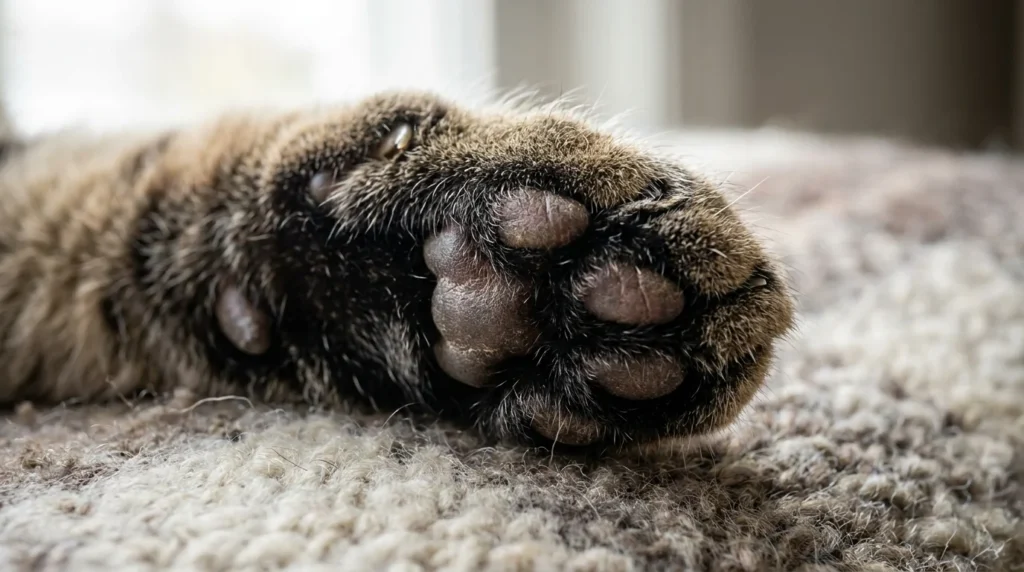
Routine paw care is usually simple and can be incorporated into grooming or quiet handling sessions. The ASPCA recommends checking paws for wounds, splinters, swelling, and other abnormalities and keeping the feet clean because substances collected on the paws may later be swallowed during grooming. Regular inspection is particularly useful for cats that go outdoors, have long fur around their feet, or are older and less able to groom themselves effectively.
A practical routine can include:
- Look at the tops and bottoms of all four paws regularly.
- Check between the toes for litter, dirt, plant material, or other debris.
- Use a clean, damp cloth for ordinary surface dirt when needed.
- Watch for redness, swelling, cracks, sores, bleeding, discharge, or odor.
- Check whether any claw is becoming unusually long or curved.
- Provide sturdy scratching surfaces in locations your cat actually uses.
- Ask your veterinarian about an appropriate nail-trimming schedule.
- Use only paw-care or moisturizing products specifically recommended as safe for cats.
Indoor cats still need paw checks because broken glass, sharp objects, hot surfaces, household chemicals, and overgrown claws can cause problems inside the home. Outdoor cats may encounter additional hazards such as rough ground, thorns, extreme surface temperatures, road chemicals, and injuries involving other animals. The goal is not constant handling but a calm, predictable routine that helps owners notice meaningful changes early.
How to Trim Cat Claws Safely
Many cats tolerate nail care better when they gradually learn that having their feet touched leads to calm handling and rewards. Start by briefly touching a paw while your cat is relaxed, and stop before the cat becomes frustrated or frightened. Over several sessions, gently press a toe pad so the claw extends and allow the cat to become comfortable with the sensation before attempting a full trim.
When trimming, remove only the sharp transparent tip and avoid the pink area known as the quick, which contains nerves and blood vessels. Good lighting and cat-specific nail clippers can make the boundary easier to see on light-colored claws, while dark claws may require a more conservative trim. If you cannot identify a safe cutting point or your cat strongly resists handling, ask a veterinarian or experienced veterinary professional to demonstrate the technique.
Common Cat Paw Problems
Because cats use their feet constantly, a wide range of relatively minor and more significant problems can affect them. Cuts, abrasions, punctures, burns, torn claws, foreign material, swelling, infection, and overgrown nails can all change the way a cat walks or uses a paw. Outdoor exposure can increase some risks, but indoor cats can also injure their feet on sharp or hot household surfaces.
| Paw problem | Signs you may notice | Sensible next step |
|---|---|---|
| Small superficial scrape | Mild tenderness or a visible shallow abrasion | Keep clean and monitor closely |
| Deep cut or puncture | Bleeding, pain, gaping tissue, unwillingness to bear weight | Contact a veterinarian promptly |
| Burn | Red, painful, blistered, raw, or damaged pad | Seek veterinary care |
| Foreign object | Repeated licking, limping, localized swelling | Have it assessed if not loose and superficial |
| Torn or broken claw | Bleeding, licking, sensitivity, hanging claw material | Veterinary guidance may be needed |
| Overgrown claw | Curved nail approaching or entering the pad | Arrange safe trimming or veterinary care |
| Infection | Swelling, discharge, warmth, odor, persistent pain | Veterinary examination is recommended |
| Unexplained swelling | Enlarged toe or paw, limping, tenderness | Veterinary examination is recommended |
Cats frequently hide pain, so limping is not the only indication that something is wrong. Repeated licking or chewing of one foot, suddenly avoiding jumps, holding a paw off the ground, becoming defensive when a foot is touched, or changing normal scratching behavior can also justify a closer look. Persistent behavioral changes should be considered alongside visible changes in the paw.
What to Do if Your Cat Injures a Paw
For a minor dirty paw without an obvious deep wound, gently rinsing away superficial debris with clean water may make inspection easier. Keep the cat indoors and discourage excessive activity while you determine whether there is bleeding, swelling, a torn claw, a burn, or something embedded in the foot. Do not apply human pain medications, harsh disinfectants, or random topical products unless a veterinarian specifically says they are appropriate for cats.
An object that is deeply embedded, significant bleeding, damaged tissue, or a painful claw injury is better handled by a veterinary professional than by repeated probing at home. A cat in pain may also bite or scratch even if it is normally gentle, which makes forceful examination risky for both the cat and owner. When the severity of an injury is uncertain, calling your veterinary clinic for triage advice is safer than waiting for obvious deterioration.
When a Paw Problem Needs Veterinary Attention
Some paw changes can be monitored briefly, but others should prompt faster professional advice. ASPCA guidance specifically highlights blood, pus, unusual odor, obsessive paw cleaning, limping, and favoring a leg as reasons to investigate and potentially seek veterinary care. Painful or significant injuries may also worsen when a cat continues walking on the affected foot.
Contact a veterinarian promptly if you notice any of the following signs.
- Bleeding that does not stop with gentle pressure.
- A deep cut, puncture, or open wound.
- A burned or blistered paw pad.
- Significant swelling or severe tenderness.
- Pus, discharge, or an unusual odor.
- An object deeply embedded in the paw.
- A claw torn close to its base.
- A nail growing into the paw pad.
- Persistent limping or refusal to bear weight.
- Repeated chewing or licking that causes skin damage.
- Sudden changes affecting several paws.
- A wound that appears to be worsening rather than healing.
This article is intended for general educational information and cannot identify the cause of an individual cat’s symptoms. Paw problems that look similar can have very different causes, and a veterinarian can examine the pads, claws, skin, joints, and deeper structures when necessary. Urgent care is particularly appropriate when there is severe pain, uncontrolled bleeding, major trauma, extensive burns, or a cat that cannot use the affected leg normally.
What Is a Polydactyl Cat Paw?
Polydactyl cats are born with more toes than the typical arrangement of five on each front paw and four on each hind paw. Extra digits are genetic. They can make the paws look wider or give them a mitten-like shape, which is why people sometimes call these cats “mitten cats” or “cats with thumbs” in everyday conversation. Any additional claws should still be checked regularly because their position can sometimes make natural wear less effective.
Extra toes by themselves do not automatically indicate that a cat is unhealthy. The practical issue for an owner is making sure every nail is accounted for during routine paw inspection and trimming, including nails that may be positioned farther from the normal weight-bearing surface. A veterinarian can assess any unusually shaped digit that becomes painful, repeatedly catches on objects, or develops an abnormal claw.
Why Cats May Dislike Having Their Paws Touched
A cat’s paw contains many sensitive nerve endings, so foot handling can feel much more intense to a cat than casual petting along the back or cheeks. Cats also depend on their feet for movement and defense, which can make restraint around the paws particularly uncomfortable for some individuals. A cat pulling its paw away is therefore not necessarily being difficult; the animal may simply be protecting a sensitive body part.
Short handling sessions are usually more productive than holding a resistant cat in place until every claw has been trimmed. Pairing gentle touches with treats and ending while the cat remains calm can gradually build tolerance. Some cats will always be easier to manage with help from a veterinary professional or experienced groomer.
Protecting Feline Paws From Heat and Cold
Paw pads are durable, but they are not immune to temperature-related injury. Very hot pavement, stoves, heating surfaces, freezing ground, ice, and deicing chemicals can damage or irritate feline feet. Cats with outdoor access should have opportunities to avoid extreme surfaces, while indoor hazards such as hot cooktops should also be considered.
Do not assume that a thick-looking pad makes a cat resistant to heat or cold. If a paw becomes red, blistered, raw, unusually discolored, or painful after temperature exposure, veterinary advice is appropriate. Prevention is much easier than treating a burn or significant tissue injury.
The Bottom Line on Paw Health
A cat’s paw is a compact system built for movement, balance, sensing, gripping, cushioning, scratching, and everyday exploration. Healthy paws can vary considerably in color and appearance, but they should allow normal movement without persistent pain, swelling, bleeding, wounds, or abnormal licking. Regular inspection, suitable scratching surfaces, careful nail maintenance, and quick attention to injuries can help protect these essential structures throughout a cat’s life.
Owners do not need to turn paw care into a complicated daily procedure. Becoming familiar with what each foot normally looks like is often the most useful first step because changes are easier to notice when you have a baseline for comparison. For more practical animal-care topics, readers can explore Magazinted’s Pets section.
Are black paw pads normal?
Yes, black or dark paw pads can be completely normal and commonly reflect natural pigmentation. Pink, brown, mixed, and mottled pads can also be healthy depending on the individual cat. Sudden changes are more important than the starting color, particularly when they occur alongside soreness, swelling, skin damage, or behavioral changes.
Frequently Asked Questions
How many toes does a normal cat have?
Most cats have 18 toes in total, with five on each front paw and four on each back paw. The fifth front digit includes the dewclaw, which sits higher than the main weight-bearing toes. Cats born with additional toes are known as polydactyl cats.
Why are cats’ paws called toe beans?
“Toe beans” is an affectionate informal name for the rounded paw pads beneath a cat’s toes. The pads may resemble small beans when the underside of the paw is visible, which explains the nickname. Anatomically, however, the paw contains several distinct pads rather than one single structure.
Do cats sweat through their paw pads?
Yes, cats have sweat glands associated with their paw pads and can sometimes leave damp footprints. These may be particularly noticeable when a cat is stressed or warm. Paw sweating is only a limited part of feline temperature regulation and should not be compared with the extensive sweating humans use to cool themselves.
Should paw pads feel rough?
A little texture can be normal because paw pads repeatedly contact floors and other surfaces. What matters more is whether a new change is accompanied by cracking, bleeding, swelling, pain, discharge, or persistent licking. If a pad suddenly looks or feels very different from your cat’s usual condition, a veterinarian can determine whether treatment is needed.
Can I put moisturizer on my cat’s paw pads?
Do not assume that a human skin cream or household oil is safe simply because it is safe on your own skin. Cats frequently lick their paws, so anything applied to the pads may also be swallowed. The ASPCA advises using a veterinarian-recommended product when moisturizing is needed, making professional guidance the safer choice.
Why does my cat keep licking one paw?
Occasional grooming is normal, but repeated attention to one foot can indicate irritation, debris, a damaged claw, discomfort, or another problem. Check the paw gently for visible changes without digging into painful tissue or forcing the cat to cooperate. Persistent licking, limping, swelling, wounds, discharge, or pain warrants veterinary assessment.
