


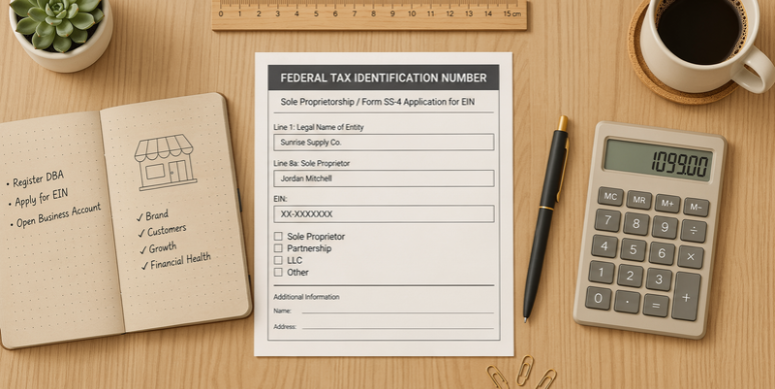
If you run a sole proprietorship, you may use your Social Security number for some federal tax purposes. A federal tax identification number sole proprietorship owners commonly use is an Employer Identification Number, or EIN. Whether you need one depends mainly on employees, tax filings, and how your business operates. Direct answer: A sole proprietor does not automatically need an EIN simply because the business exists. You generally need one when you hire employees or file certain pension or excise tax returns. You can also request an EIN for legitimate business purposes even when federal law does not require one.
| Key question | What U.S. sole proprietors should know |
|---|---|
| What is the number called? | Employer Identification Number, or EIN |
| Who issues it? | Internal Revenue Service |
| How many digits? | Nine digits |
| Is every sole proprietor required to have one? | No |
| When is it generally required? | Employees and certain pension or excise tax filings |
| Does the IRS charge for an EIN? | No |
| Can you apply online? | Yes, if eligible for the IRS online application |
| Do multiple sole-proprietor businesses need separate EINs? | Generally no |
| Can changing your business structure require a new EIN? | Yes, in several situations |
What Is a Federal Tax Identification Number for a Sole Proprietorship?
A federal tax identification number generally means an EIN when discussing a business. The IRS assigns EINs for federal tax filing and reporting purposes. As the IRS employer ID number guidance explains, an EIN has nine digits, in a format such as 12-3456789. A sole proprietorship is different from a corporation or partnership. The owner and business are generally not separate federal income-tax entities. This difference explains why many sole proprietors can use an SSN in situations where another business must use an EIN. The EIN does not replace your SSN for every personal tax purpose. The IRS says an EIN is intended for business activities. You should use the correct taxpayer number requested by each federal form.
Federal Tax Identification Number Sole Proprietorship Requirements

The Federal Tax Identification Number Sole Proprietorship clearest EIN requirement applies when a sole proprietor becomes an employer. The IRS states that businesses reporting employment taxes need an EIN. A sole proprietor paying wages to one or more employees therefore generally needs one. Certain tax obligations can also trigger the requirement without regular employees. IRS Publication 334 identifies pension and excise tax returns as examples. Other specialized federal filing requirements can also require an EIN. A freelancer or independent contractor working alone may not face those conditions. In that case, the owner may often use an SSN for federal income-tax reporting. The specific form and activity still determine which number belongs on a filing.
When a sole proprietor generally needs an EIN
Common situations include the following.
* Hiring one or more employees. * Reporting federal employment taxes. * Filing certain excise tax returns. * Maintaining certain retirement arrangements. * Handling other federal filings that specifically require an EIN. * Conducting legitimate business activities where an EIN is requested.
The IRS also recognizes business-purpose requests from sole proprietors. Its current internal guidance lists independent contracting with a federal agency among legitimate reasons. Establishing certain self-employed retirement accounts can also support an EIN request.
Can You Get an EIN Even When It Is Not Required?
Yes, a sole proprietor may request an EIN for a legitimate business reason. The IRS does not limit EINs only to businesses with employees. This can give an owner another taxpayer identification number for permitted business uses. An EIN can also reduce how often you provide your SSN in certain business settings. That does not mean every bank or payer must accept the EIN. Their documentation requirements can depend on the transaction and applicable tax rules. For example, Form W-9 instructions say a sole proprietor with an EIN may enter either an SSN or EIN. Different rules apply to some single-member LLC arrangements. Always follow the instructions for the specific form you are completing. Business owners organizing records and financial procedures may also benefit from reviewing Magazinted’s guide to improving core business processes. Good records make tax filing, banking, and identity verification easier to manage.
How to Apply for an EIN as a Sole Proprietor
The IRS recommends electronic applications when the online system is available to you. Applicants with a principal business location in the United States or U.S. territories can generally apply online. The IRS provides the EIN without an application fee. You can also apply using Form SS-4 by fax or mail. International applicants who cannot use the online system have separate procedures. Current IRS instructions provide the applicable telephone and paper-application options. Before starting, gather your legal name and taxpayer identification information. You will also need basic details about the business and its activities. Accurate information helps the IRS establish the correct business tax account.
Basic EIN application steps
1. Confirm that you need or have a legitimate business reason for an EIN. 2. Gather the owner and business information required by Form SS-4. 3. Use the official IRS online application when you are eligible. 4. Complete the application using your correct legal and trade names. 5. Save the EIN assignment notice with your permanent business records.
Do not pay an unnecessary third party simply to obtain the number. The IRS issues EINs free of charge. Paid services may charge for assistance, but the federal EIN itself has no IRS application fee. Readers building broader business systems can browse Magazinted’s Finance section for related financial topics. Its coverage includes merchant costs, business financing, and other operating concerns.
Do You Need a Separate EIN for Every Sole Proprietorship?
Usually, no. Current IRS Form SS-4 instructions say a sole proprietor generally files only one Form SS-4. The owner normally keeps one EIN despite operating several sole-proprietor businesses or trade names. IRS internal guidance says the same EIN generally applies across businesses owned by the same sole proprietor. Opening a second sole proprietorship by itself does not require another EIN. This is an important distinction for owners with several brands or DBAs. That rule does not mean an EIN can follow a business through every possible ownership change. Certain legal changes create a new taxpayer entity. Those changes can create a new EIN requirement.
When Does a Sole Proprietor Need a New EIN?
A new EIN can become necessary when the business changes ownership or legal structure. IRS guidance identifies incorporation and conversion to a partnership as important examples. A change from one individual owner to another can also require a new number. Certain bankruptcy and post-death situations have separate rules as well. The details can become more complicated than a standard business-name change. Professional tax or legal guidance can be useful when ownership changes. A simple new trade name usually does not create the same result. Neither does opening another sole-proprietor business under the same individual owner. The tax identity follows the taxpayer rules rather than each marketing name.
EIN, SSN, and Single-Member LLC: Know the Difference
Sole proprietorships and single-member LLCs can look similar for federal income-tax purposes. They are not always treated identically for every filing. A disregarded single-member LLC may need to use the owner’s SSN or EIN for certain income-tax reporting. Employment taxes create another distinction. The IRS can require a disregarded entity to use its own name and EIN for employment-tax reporting. Owners should not assume one identification rule applies to every federal form. If you operate through an LLC, check the instructions for that entity and tax election. Do not rely only on general sole-proprietor guidance. Your state may also impose separate registration or identification requirements.
Protect and Maintain Your EIN Records
Keep your EIN assignment notice with permanent business records. Banks, government agencies, payroll providers, or other organizations may later request verification. The IRS now allows eligible Business Tax Account users to obtain an EIN verification notice online. You should also keep the IRS informed when certain business information changes. Form SS-4 instructions direct businesses to use Form 8822-B for responsible-party or address changes. Responsible-party changes generally must be reported within 60 days. Treat your EIN as sensitive business information. It is not secret in exactly the same way as an SSN, but misuse can still create problems. Share it only when a legitimate business or tax purpose requires it.
The Bottom Line
A federal tax identification number a sole proprietorship owner needs depends on the business’s federal tax obligations. Hiring employees and filing certain pension or excise returns are common triggers. Sole proprietors without those requirements may still request an EIN for a legitimate business purpose. Apply directly through the IRS when you determine an EIN is appropriate. Keep the assignment notice with your business records after approval. If ownership or entity structure changes, check whether the IRS requires a new number. For more business and money topics, explore Magazinted’s Finance coverage. Tax rules can change, so use current IRS instructions or qualified professional advice for individual decisions. —
Frequently Asked Questions
Does a federal tax identification number a sole proprietorship owner uses have to be an EIN?
Not always. A sole proprietor can use an SSN for some federal income-tax and information-reporting situations. An EIN becomes required when specific federal tax obligations apply.
Is an EIN the same as a federal tax ID?
An EIN is one type of federal taxpayer identification number. Businesses commonly use “federal tax ID” as another name for an EIN. Other taxpayer numbers include SSNs and ITINs.
Is an EIN free for a sole proprietor?
Yes, the IRS issues an EIN without charging an application fee. You can apply through the official IRS process if eligible. Private companies may charge separately for application assistance.
Can I use my EIN instead of my SSN on Form W-9?
A sole proprietor who has an EIN may generally enter either an SSN or EIN under current Form W-9 instructions. The rules differ for some disregarded single-member LLCs. Follow the form instructions for your exact ownership structure.
Do I need a new EIN if I change my business name?
A business-name change alone generally does not create a new entity. A new EIN is more commonly triggered by ownership or entity-structure changes. Confirm your situation with current IRS guidance before applying again.
Can one person have several sole proprietorships under one EIN?
Generally, yes. IRS guidance says an individual sole proprietor normally has one EIN for sole-proprietor business activities. Opening an additional sole proprietorship does not normally require another EIN.
