


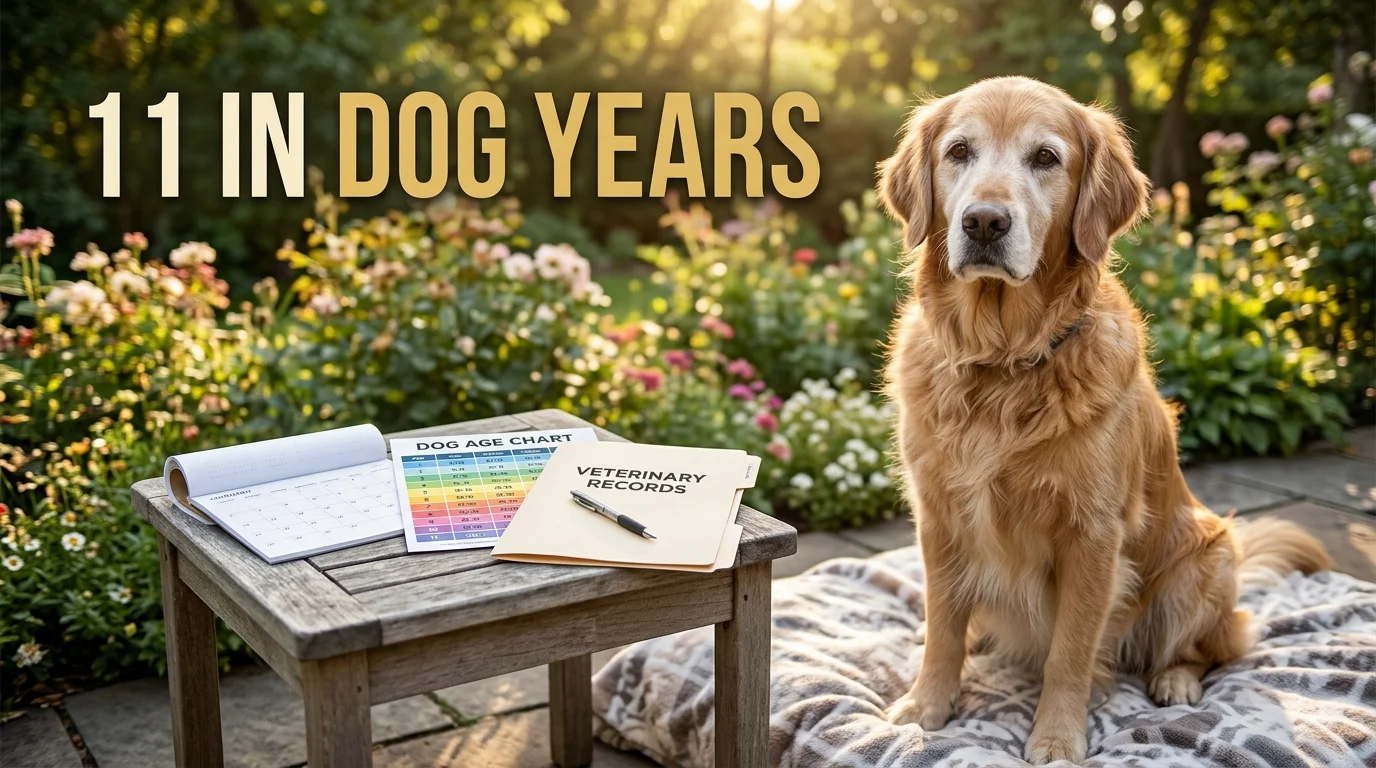
If you’re converting 11 in dog years, the answer depends mainly on your dog’s size. An 11-year-old dog is roughly 60 to 86 human years old. Smaller dogs generally age more slowly during later life than larger dogs.
Quick answer: An 11-year-old small dog is about 60 human years old. A medium dog is about 65, while a large dog is around 72. A giant dog may be comparable to a person around 86 years old.
| Dog size | Typical adult weight | Approximate human age at 11 |
|---|---|---|
| Small | 20 pounds or less | 60 years |
| Medium | 21–50 pounds | 65 years |
| Large | 51–90 pounds | 72 years |
| Giant | More than 90 pounds | 86 years |
These figures are estimates, not exact biological conversions. Breed, genetics, health, weight, and lifestyle can influence how an individual animal ages. Still, size-based charts give owners a more useful comparison than the old seven-times rule.
Why 11 in Dog Years Is Not Simply 77 Human Years
The traditional calculation multiplies a dog’s age by seven. That method would make an 11-year-old dog equal to a 77-year-old person. Modern veterinary guidance shows canine aging does not follow such a straight line.
Dogs mature much faster during their first years than people do. Their later aging rate also varies according to body size and breed. This explains why one formula cannot accurately describe every dog.
A small companion breed and a giant breed can share the same birthday. Yet their physical aging may look quite different by age eleven. Size-based comparisons provide a clearer picture of their relative life stages.
11-Year-Old Dog Age by Size
An 11-year-old small dog is commonly estimated at about 60 human years. Examples include many Chihuahuas, Maltese, Shih Tzus, and other compact breeds. Individual breed characteristics can still move the comparison in either direction.
A medium dog at eleven is approximately comparable to a 65-year-old person. This size group generally includes dogs weighing about 21 to 50 pounds. Their aging rate usually falls between small and large breeds.
A large dog may be around 72 human years at the same calendar age. Larger bodies tend to experience age-related changes earlier than smaller ones. Owners may therefore notice mobility or stamina changes sooner.
Giant dogs can reach an approximate human equivalent of 86 years by age eleven. Their expected lifespans are often shorter than those of small breeds. Reaching this age can therefore represent an advanced stage of life.
Why the “One Dog Year Equals Seven Human Years” Rule Is Misleading
The seven-year formula became popular because itis easy to remember. Unfortunately, canine development is not linear enough for that shortcut. A one-year-old dog is far more mature than a seven-year-old child.
Many common charts place a one-year-old dog near the mid-teen human stage. By age two, the comparison commonly reaches the early twenties. Aging then progresses at different rates according to size.
This pattern makes the early years especially important in any calculation. Simply multiplying every birthday by seven ignores rapid early development. It also ignores the faster later-life aging seen in larger breeds.
Is an 11-Year-Old Dog Considered Senior?
An 11-year-old dog is usually considered a senior. Veterinary life stages depend partly on expected lifespan rather than one universal birthday. The American Animal Hospital Association defines senior status around the final quarter of expected lifespan.
For many dogs, age eleven clearly falls within that period. Giant and large breeds often enter later-life stages earlier than small breeds. Some smaller breeds can remain active well into their teens.
Senior status does not automatically mean a dog is unhealthy. Older animals can remain playful, interested, and comfortable for years. The label mainly helps owners and veterinarians adjust preventive care.
What Changes Should You Expect at Age 11?
Many older dogs sleep more and recover more slowly after demanding activity. They may also lose some muscle or become less flexible. These changes can develop gradually enough that owners overlook them.
Vision and hearing may also decline with age. A dog might respond more slowly when called or hesitate in dark areas. Sudden changes deserve veterinary attention rather than being dismissed as normal aging.
Behavior can change too, especially when pain or cognitive problems develop. New anxiety, nighttime pacing, confusion, or house-soiling should be discussed with your veterinarian. Early evaluation can identify manageable medical causes.
If you own a larger mixed breed, Magazinted’s Rottweiler Pitbull mix owner’s guide also covers health and lifespan considerations. These issues can differ substantially from dog to dog. Breed ancestry should support care decisions, not replace veterinary assessment.
Caring for an 11-Year-Old Dog
Regular veterinary visits become especially useful during the senior years. AAHA guidance recommends at least twice-yearly physical examinations for senior dogs. Your veterinarian may suggest bloodwork or other screening based on individual risks.
Weight management also deserves close attention. Extra body weight can strain aging joints and reduce comfortable movement. Ask your veterinarian about suitable calories, body condition, and nutritional needs.
Continue exercise unless your veterinary team advises otherwise. Shorter walks, gentle play, and controlled activity can help preserve strength. The best routine depends on mobility, heart health, joints, and stamina.
Dental care remains important at this age. Oral pain can make eating uncomfortable and may go unnoticed. Regular exams help identify dental disease before it becomes harder to manage.
For broader animal-care reading, visit Magazinted’s Pets section. Owners researching canine terminology can also read the guide explaining what a female dog is called. These resources cover related questions for U.S. pet owners.
Signs Your Senior Dog Should See a Veterinarian
Normal aging should not cause persistent suffering or sudden physical decline. Rapid changes can signal illness, injury, dental problems, or pain. Contact your veterinary clinic if something clearly differs from your dog’s normal pattern.
Watch for changes involving appetite, drinking, urination, breathing, or body weight. Persistent vomiting, diarrhea, coughing, weakness, or unusual fatigue also deserve attention. Don’t assume difficulty standing or walking is simply age-related.
Behavioral changes can be equally meaningful. Confusion, restlessness, aggression, or withdrawal may have medical causes. Keeping notes about when symptoms appear can help your veterinarian evaluate them.
Does Breed Affect the Human-Age Comparison?
Yes, breed can change how useful any general age chart is. Two dogs of identical weight may still have different expected lifespans. Genetics and breed-related health risks influence their aging patterns.
Large breeds often have shorter average lifespans than many small breeds. That means an older large dog can be further along in its expected lifespan. A small dog of the same calendar age may have more years ahead.
Mixed-breed dogs can be harder to categorize precisely. Adult weight provides a practical starting point when ancestry is uncertain. Your veterinarian can add health history and physical condition to that estimate.
Can You Calculate a Dog’s Exact Human Age?
No universally accepted conversion produces an exact human equivalent. Size-based charts provide approximations designed to make canine aging easier to understand. They should not be treated like medical measurements.
Researchers have also studied biological markers connected with aging. Some formulas use molecular changes instead of simple calendar comparisons. Those methods can produce different results from traditional veterinary charts.
For everyday owners, the practical lesson is straightforward. Use age comparisons to understand life stage rather than chase one perfect number. Your dog’s health and behavior matter more than the calculated equivalent.
Frequently Asked Questions
What is 11 in dog years in human years?
The estimate ranges from about 60 to 86 human years. Small dogs sit near the lower end of that range. Giant breeds usually fall near the upper end because they age faster later in life.
Is 11 old for a dog?
Yes, eleven is a senior age for most dogs. The degree of aging depends heavily on breed, size, and health. Some small dogs remain energetic and healthy for several additional years.
Is an 11-year-old dog equal to a 77-year-old human?
Not necessarily, although multiplying by seven produces 77. That shortcut does not reflect rapid early development or size differences. Modern charts usually provide a range instead of one universal answer.
How old is an 11-year-old small dog in human years?
A small dog of this age is approximately comparable to a 60-year-old person. This estimate usually applies to dogs weighing around 20 pounds or less. Breed and individual health can change what that comparison means in practice.
How old is an 11-year-old large dog in human years?
A large dog at eleven is roughly comparable to a person around 72. Giant breeds can reach an estimated equivalent near 86. These numbers are useful guides, not exact biological ages.
The Bottom Line
At eleven, your dog’s human-age equivalent depends much more on size than simple multiplication. Small dogs are near 60, while giant dogs can approach the mid-eighties. Medium and large dogs generally fall between those points.
The number matters less than recognizing your dog’s current life stage. Watch mobility, appetite, weight, behavior, dental health, and energy over time. Regular veterinary care can help you respond early when meaningful changes appear.
Use the chart as a quick reference, then consider your dog as an individual. Breed, health history, body condition, and lifestyle all add useful context. For an older pet, comfort and preventive care should remain the main priorities.
