


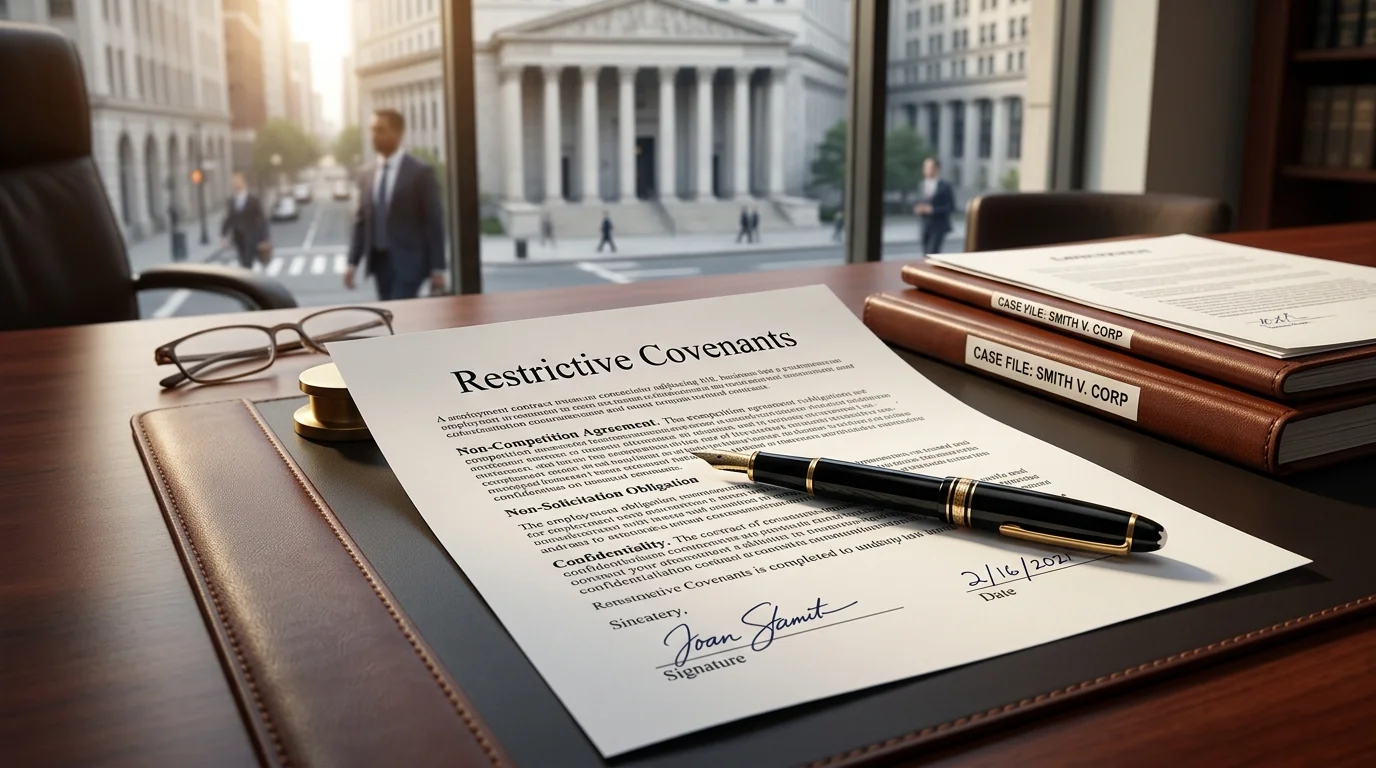
Restrictive covenants can appear in employment agreements, business contracts, property deeds, and homeowners association documents. Although the same legal term is used in each setting, the restriction may affect very different rights, from where an employee can work after leaving a company to how a homeowner can use or modify a property. Understanding the context is therefore the first step before deciding whether a covenant is valid or enforceable.
In the United States, no single rule determines whether every restrictive covenant can be enforced. Employment restrictions are governed largely by state law, while real-estate covenants depend on property law, the language of the recorded restriction, and state-specific enforcement rules. A provision that is valid in one state or situation may be limited or completely unenforceable in another.
Direct answer: Restrictive covenants are contract or deed provisions that limit certain activities, such as competing with a former employer, soliciting clients, or using property in specified ways. In the United States, enforceability depends on the covenant’s context and state law. Some restrictions are valid, while others are narrowed or unenforceable.
| Context | Common restrictive covenant | What it may limit | Main legal question |
|---|---|---|---|
| Employment | Noncompete | Working for or starting a competing business | Is the restriction lawful and reasonable under state law? |
| Employment | Nonsolicitation | Contacting former customers or employees | Does it protect a legitimate business interest without going too far? |
| Employment | Confidentiality clause | Using or disclosing confidential information | Is the protected information legitimately confidential? |
| Real estate | Deed restriction or CC&R | Construction, property use, appearance, rentals, or other activities | Does the covenant bind the property and remain legally enforceable? |
| Real estate | Covenant running with the land | Future owners as well as the original owner | Does state property law allow the restriction to continue with ownership? |
What Are Restrictive Covenants?
A restrictive covenant is a legal promise that limits certain conduct. In property law, Cornell Law School’s Legal Information Institute describes the term as a provision in a real-property conveyance that restricts how the grantee may use the property. In employment and business law, the term also commonly refers to contractual restrictions involving competition, solicitation, confidential information, and similar post-employment activities.
The important point is that “restrictive covenant” is an umbrella term rather than the name of one specific restriction. A person reviewing an employment contract may be dealing with a noncompete clause, while a homeowner searching the same phrase may be dealing with an HOA rule recorded against a subdivision. The legal analysis changes depending on which type of covenant is involved.
Readers who regularly encounter unfamiliar contractual terminology can also review Magazinted’s guide to understanding legal jargon for a broader introduction to interpreting legal documents. The article explains why definitions, context, and careful reading matter when legal language affects rights or responsibilities. Those same habits are useful when reviewing a restrictive covenant. Understanding Legal Jargon on Magazinted
Employment Restrictions: Noncompetes and Related Clauses
These employment restrictions are contractual provisions designed to limit certain activities during employment or after the employment relationship ends. Common examples include noncompetition provisions, customer nonsolicitation provisions, restrictions on recruiting former coworkers, and confidentiality agreements. The American Bar Association notes that enforceability depends heavily on state law and that many jurisdictions examine whether the restriction is reasonable and connected to a legitimate business interest.
An employer may use a covenant to protect trade secrets, confidential business information, customer relationships, or goodwill. However, simply wanting to prevent ordinary competition does not automatically make every restriction enforceable. Courts and legislatures can limit agreements that impose broader restrictions than the applicable law permits.
Noncompete Agreements
A noncompete generally prevents a worker from engaging in specified competitive activity after employment ends. Depending on its wording, it may restrict employment with a competitor, opening a competing business, or providing certain services within a defined market, geographic area, or period. Cornell notes that many states have historically permitted reasonable noncompetes, while other states prohibit or substantially limit them.
The details matter because a two-year restriction covering one specialized activity may be treated differently from a provision that effectively blocks someone from working anywhere in an entire industry. State statutes may also impose requirements based on compensation, occupation, notice, or other factors. For that reason, a clause should not be assumed valid merely because it appears in a signed employment agreement.
Nonsolicitation Agreements

A customer nonsolicitation covenant usually restricts a former employee from actively pursuing customers or clients connected with the former employer. A separate employee nonsolicitation or anti-raiding provision may restrict attempts to recruit former coworkers to another company. These provisions can sometimes receive different treatment from a full noncompete because they do not necessarily prevent a person from working for a competitor altogether.
The exact wording matters because a restriction aimed at active solicitation differs from one that attempts to prohibit nearly every form of contact or business relationship. Courts may consider the people covered, the restriction’s duration, the employee’s role, and the business interest the employer claims. State law ultimately determines which standards apply.
Confidentiality and Trade-Secret Restrictions
Confidentiality provisions restrict the use or disclosure of protected information. They may cover proprietary data, customer information, internal strategies, technical information, or genuine trade secrets, although not everything an employee learns at work automatically qualifies for unlimited protection. A carefully drafted confidentiality obligation can also operate differently from a noncompete because it regulates protected information rather than directly prohibiting future employment.
These distinctions become especially important when a contract contains several of these clauses together. An agreement might include a noncompete, a customer nonsolicitation clause, an employee nonsolicitation provision, and confidentiality obligations in separate sections. Each provision may need to be analyzed independently under the governing law.
Are Employment Noncompetes Enforceable in 2026?
There is currently no effective nationwide FTC rule that automatically bans employee noncompetes across the United States. The Federal Trade Commission states on its Noncompete Rule page that the 2024 rule is not in effect or enforceable. A federal district court stopped enforcement, and the FTC moved in September 2025 to dismiss its appeals and accept the rule’s vacatur. In February 2026, the agency also took action to conform its regulations to those federal court decisions.
That means employers and workers still need to examine the law of the relevant state rather than relying on a nationwide rule. Some states sharply restrict noncompetes, while others allow certain agreements when statutory or common-law requirements are satisfied. Courts in states that use a reasonableness approach may examine issues such as duration, geographic reach, restricted activities, hardship to the worker, and the employer’s legitimate interests.
The absence of a nationwide ban does not mean federal regulators have abandoned the issue. In June 2026, for example, the FTC finalized a consent order requiring Rollins Inc. to stop enforcing noncompetes against more than 18,000 workers after alleging that the company’s agreements were unfair and anticompetitive. The case shows why employers should not treat every noncompete as automatically safe simply because the broader FTC rule was vacated.
What Makes an Employment Restrictive Covenant More Likely to Be Enforced?
Where state law allows such restrictions, enforceability often turns on whether the provision protects a legitimate business interest without imposing unnecessary restraints. Factors can include how long the restriction lasts, the activities it covers, its geographic scope, the employee’s position, and whether the employer has a genuine interest such as confidential information or important customer relationships. A restriction that reaches substantially beyond the interest it claims to protect may face greater legal difficulty.
The circumstances surrounding the agreement can matter as well. Certain states impose notice rules, compensation thresholds, timing requirements, or other statutory conditions before some covenants can be enforced. Because these rules can change, employers and workers should verify the current law of the relevant state rather than relying on a generic contract template.
Employment restrictions may also affect what happens after a person leaves a job, changes industries, or starts a business. Magazinted covers related workplace issues in its employment-focused content, including how legal and practical employment rules can affect workers. Readers researching the broader relationship between employment records and job opportunities can explore its discussion of online criminal records and employment. Online Criminal Records and Employment on Magazinted
Deed Restrictions and CC&Rs in Real Estate
In real estate, a restrictive covenant generally limits how land or property can be used. These restrictions can appear in deeds, subdivision declarations, homeowners association documents, or covenants, conditions, and restrictions commonly called CC&Rs. Typical provisions may regulate structures, fencing, exterior changes, property use, parking, rentals, landscaping, or other activities affecting a neighborhood or development.
Some property covenants can “run with the land,” meaning the restriction may bind later owners rather than only the people who originally agreed to it. Cornell explains that traditional legal tests have considered matters such as intent, notice, whether the covenant concerns the land, and forms of legal privity, although jurisdictions can apply different standards. Buyers should therefore review recorded property documents before assuming a prior owner’s agreement disappeared when the property was sold.
For broader property-related reading, Magazinted maintains a Real Estate section covering homeownership and real-estate topics. That category can provide useful background when restrictive covenants arise during a purchase, sale, or ownership dispute. Still check property-specific legal questions against local law and the recorded documents. Magazinted Real Estate section
Examples of Deed and Subdivision Restrictions
A subdivision covenant might limit a fence’s location or height, restrict certain structures, impose architectural standards, or regulate how a lot may be used. Another covenant might require approval before significant exterior alterations or place conditions on particular activities within the community. Whether such a provision can actually be enforced depends on its language, the applicable property law, and other circumstances.
Restrictive covenants also differ from government zoning rules. A covenant generally arises from a private agreement or recorded property restriction, while zoning requirements are imposed through government land-use authority. A homeowner may therefore need to comply with both a valid private covenant and applicable zoning or building requirements.
Property disputes can overlap with other legal concepts as well. Magazinted’s explanation of condemnation, for example, discusses how the term can relate to eminent domain or unsafe-property determinations, which are legally different from ordinary private deed restrictions. Recognizing those distinctions prevents unrelated real-estate rules from being treated as interchangeable. Condemnation Meaning on Magazinted
What About Racial Restrictions in Older Deeds?
Older property records sometimes contain racial restrictions created during periods of legally enforced or privately organized housing segregation. In Shelley v. Kraemer, decided by the U.S. Supreme Court in 1948, the Court held that state-court enforcement of racially restrictive property covenants violated the Equal Protection Clause of the Fourteenth Amendment. Those discriminatory historical provisions therefore do not operate like ordinary modern land-use restrictions.
Federal fair-housing protections also prohibit discrimination in housing based on protected characteristics, including race, color, national origin, religion, sex, familial status, and disability. A historical discriminatory sentence may still physically appear in an old deed or title record even though it cannot lawfully operate as an enforceable racial exclusion. Anyone concerned about removing historical language from recorded documents should check the procedure available under the law of the state where the property is located.
Can a Restrictive Covenant Be Removed or Changed?
Sometimes, but no universal U.S. procedure exists to eliminate every restrictive covenant. The available route may depend on who created the covenant, whether it runs with the land, whether an HOA or other beneficiaries have amendment rights, whether the restriction has expired, and what state law permits. A title professional or real-estate attorney can review the recorded documents and determine which procedure applies.
An employment covenant can also be changed through negotiation, amendment, waiver, settlement, or another legally recognized process. If a provision is challenged in court, the result depends on applicable state law and the covenant itself, and courts in different jurisdictions do not always handle overly broad restrictions in the same way. Some may decline enforcement, while others may have the authority, in appropriate circumstances, to enforce only a narrower portion.
What Happens If Someone Violates a Restrictive Covenant?
A party seeking enforcement may ask a court for an injunction, which is an order requiring certain conduct to stop or directing compliance with a legal obligation. Depending on the agreement and applicable law, a lawsuit might also involve claims for financial damages, contractual remedies, attorney fees, or other relief. The fact that a violation is alleged does not automatically establish that the restriction itself is valid.
The person accused of violating the covenant may challenge its enforceability, interpretation, scope, or application. In an employment dispute, state noncompete law can become central, while a property dispute may depend on title records and state real-estate law. Because an injunction can quickly affect employment, business activity, or property use, legal advice may be especially important when litigation is threatened.
How Should You Review a Restrictive Covenant Before Signing?
Start by identifying exactly what conduct the agreement restricts and how long the restriction lasts. Determine whether it applies only to specific customers, confidential information, competing work, property alterations, or a much broader category of activity. The governing-law clause, geographic language, definitions, exceptions, and enforcement provisions deserve the same attention as the main restriction.
Next, identify which state’s law governs the agreement or property. This matters especially with employment covenants because workers and employers may operate across state lines, while real-estate restrictions are tied to property in a particular jurisdiction. General online information can help explain terminology, but it cannot determine enforceability in a specific dispute.
Finally, consider the consequences before signing rather than waiting until a conflict occurs. Employees should understand how a covenant could affect a future job or business, while buyers should review deed restrictions and association documents before purchasing property. If a provision could materially affect income, a business, or valuable real estate, advice from an attorney licensed in the relevant state can help clarify the actual risk.
Frequently Asked Questions
What is a restrictive covenant in simple terms?
A restrictive covenant is a legal promise that limits what a person is allowed to do. It may restrict post-employment competition, solicitation, disclosure of confidential information, or the use of real property. The exact meaning depends on the contract, deed, or other document in which the covenant appears.
Is a restrictive covenant the same as a noncompete?
No, although a noncompete is one type of restrictive covenant. The broader category can also include nonsolicitation agreements, confidentiality provisions, employee-recruitment restrictions, and real-estate deed restrictions. Treating every restrictive covenant as a noncompete can therefore lead to an incorrect legal analysis.
Are noncompete agreements banned in the United States in 2026?
As of September 2026, the FTC has no effective nationwide ban on employee noncompetes. The FTC states that its 2024 Noncompete Rule is not in effect or enforceable after federal litigation, so state law remains critical. Individual agreements may still be prohibited, limited, or enforceable depending on the relevant jurisdiction and facts.
Do deed restrictions stay with a property after it is sold?
Some can, particularly when a covenant legally runs with the land. Whether a future owner is bound depends on the covenant’s nature and applicable state-law requirements. A buyer should review the deed, title materials, CC&Rs, and other recorded documents before closing.
Can an HOA enforce a restrictive covenant?
An HOA may have authority to enforce valid restrictions contained in governing documents, but its powers are not unlimited. The association must act within the governing documents and applicable state and federal law. Whether a specific HOA covenant is enforceable depends on the language and local law.
Can a court enforce an old discriminatory property covenant?
Racially restrictive housing covenants cannot be judicially enforced to exclude people based on race. The Supreme Court’s decision in Shelley v. Kraemer established that state-court enforcement of such racial restrictions violates the Fourteenth Amendment. Modern federal fair-housing law also prohibits discrimination based on specified protected characteristics.
The Bottom Line
Restrictive covenants can affect employment opportunities, business relationships, confidential information, homeownership, and the future use of real estate. The term covers several different legal restrictions, so the first question should always be what the covenant actually prohibits and which law controls it. In the United States, enforceability is highly dependent on context and jurisdiction.
For employees, the most important 2026 point is that no effective nationwide FTC noncompete ban exists, making state law especially important. For property owners, recorded deed restrictions and CC&Rs can sometimes continue beyond the original owner, while unlawful discriminatory restrictions cannot be enforced. Anyone facing a covenant with significant financial, employment, or property consequences should have the actual document reviewed under the law of the relevant state.
